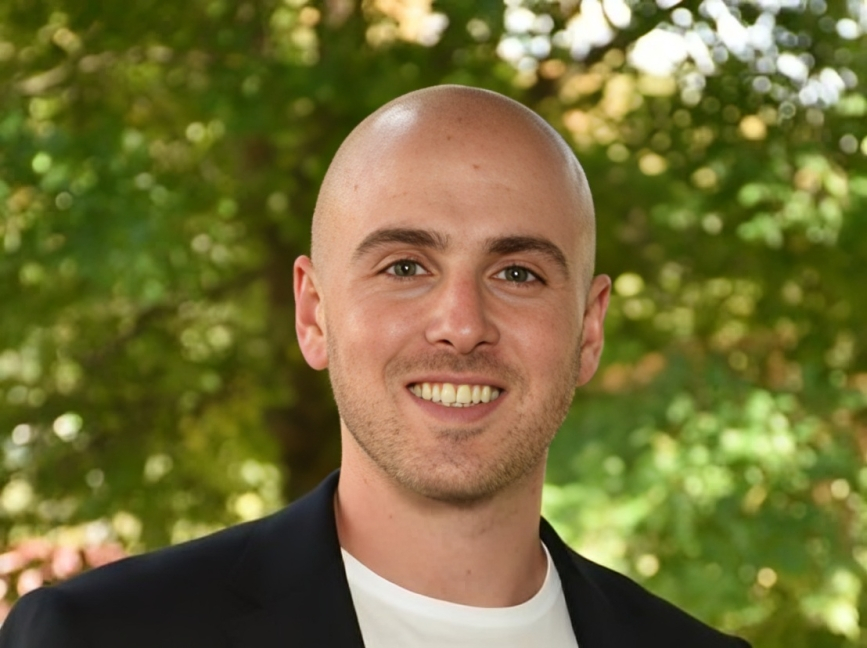
A good way to determine whether the MBA path is right for you, as well as how to go about it, is to hear from students who were in your shoes as applicants not long ago. This is what Spring Admits is about, bringing you tips and insights from past Spring clients and current MBA students of various business schools and industry backgrounds. Our current interviewee is Jonathan Schwartz, a Chicago Booth MBA Candidate (class of 2027).
Where does this blog post find you today?
I’m in the first quarter of my second year at Booth (can’t believe I’m already a second year student), studying for midterms and enjoying the Halloween weekend here in Chicago.
Walk us through your pre-MBA background.
I’m originally from Israel and moved to New York for my undergrad at Columbia University, where I studied Computer Science and Mathematics. I was always drawn to tech, so after graduating I joined Hyro, an early-stage health tech startup, as a software engineer. Over time I grew into an engineering manager role, and in my last position I led the team building Hyro’s chat AI agents. Right before the MBA, I also interned as a product manager at a VC fund, building and implementing AI products for the investment team.
What made you decide to pursue an MBA?
I’d spent years on the technical side, and I wanted to make the transition into more business-related roles. An MBA felt like the right way to do that. It would give me a well-rounded education in the areas I hadn’t had much exposure to, like finance, accounting and marketing, which I knew would help me professionally but also genuinely interested me on a personal level.
I also saw it as a chance to meet people from completely different backgrounds and countries. That turned out to be exactly what happened.
Why did you choose this particular school?
First, it’s simply an amazing school. Booth has some of the best faculty in the world, and I was really drawn to that.
Second, the flexible curriculum. Most MBA programs have a rigid core you have to get through. Booth’s approach is basically “you’re adults, choose your own classes.” From day one I could take advanced classes in areas where I already had experience and intro classes in areas where I didn’t. I could also plan my schedule around recruiting each quarter, which made a big difference.
Third, Chicago. Coming from New York, I wanted to stay in a big, dynamic city, with great restaurants, culture, nightlife and always something going on. Chicago has all of that, and on top of it, it’s a beautiful city.
Can you share a little about recruitment? What roles have you targeted, and why?
For my summer internship, I mainly recruited for product management roles in tech. I wanted to stay in tech but move toward the business side, and PM felt like the natural bridge.
During the spring quarter, a professor from UChicago’s Computer Science department reached out to me. He was looking for MBA students to help with the business side of his research: market research, a business plan, and figuring out how to turn the technology into a product. The research was a hardware accelerator for graph computations, and I joined because it was just really interesting. Toward the end of the quarter, he asked me to join UpDown Computing, the semiconductor startup he spun out of the research, for the summer. I was the only person on the business side, covering go-to-market, business development and product.
It connected to my background more than I expected. At Hyro, I worked a lot with graphs to help our AI agents find the right information, so I already understood the technical problem, which is pretty complicated on its own. I had no business development experience, but because the product is so technical, my engineering background helped me understand how to position it and take it to market. It was a combination of learning the business side on the job and leaning on my technical background.
What surprised you about the actual MBA experience?
You know going in that an MBA is about the people: the connections, the social events, the clubs, balancing recruiting with school and social life. But knowing it and experiencing it are two different things. Even though I knew what to expect, I was still surprised by the extent of it, and I’ve honestly enjoyed every part of it.
People also love to travel. There are the official treks, and the Colombia trek was a one-of-a-kind experience. I had an amazing time. Then there are the unofficial ones: ski trips, or the weekend a group of us flew to a good friend’s home in Mexico in the middle of the coldest weekend of the Chicago winter.
What makes your school unique?
There are so many opportunities, and it’s really up to you to decide what to focus on. Some people put more emphasis on networking, others on the academics. How much you put in is how much you get out.
The ability to take very advanced classes with world-class professors was a big plus for me. But there are also so many unconventional ways to learn and gain experience. Through the Polsky Center I did the VC Lab, working at a venture capital fund twice a week for a full quarter. There’s the New Venture Challenge, Booth’s startup accelerator and competition, plus hackathons, the Venture Capital Investment Competition, and lots of smaller opportunities to get hands-on experience.
And then there are moments that only happen at a place like this. I went to a lecture by Richard Thaler, the Nobel laureate who used to teach at Booth, and remember thinking how cool it was to be in that room.
What is it like living in the city/town where the campus is located?
Booth’s main campus is in Hyde Park, but most full-time students live downtown.
Most of my classmates live in a few buildings that are literally across the street from each other, so it feels like everyone lives together. Before an event or a party, people meet on one of the rooftops, and there’s always something happening in one of the buildings or a bar nearby. There’s a really strong sense of community.
And then there’s Chicago itself: amazing restaurants, bars, concerts, and summers and fall are incredible. It’s a great city to be in regardless of Booth, and then you have everything happening with the MBA on top of that. I really love living here.
Any misconceptions about your program you’d like to clear up?
“UChicago is where fun goes to die.” I’m not even sure that’s true for the undergrad, but it’s definitely not true for Booth. The academics are excellent, but it’s still an MBA, with all the social events, parties and trips that come with it.
The other one is the winters. Honestly, that one’s partly true, the winters are hard. But you go through it together with your classmates, and it passes faster than you’d think. Compared to everything else about Booth, it’s a small thing.
What advice would you give to MBA applicants to your school, or in general?
The most boring answer is also the most important one: be genuine about your experience and about what you want from an MBA. Put real time into soul-searching about what you want from the MBA and the years after it, then find the stories that show it. If you do that well, you’ll end up at the right school for you.
Spend a lot of time preparing for interviews. In the end, they want to connect your stories to a person who can articulate themselves well and represent the school.
Something I realized after getting in, and this is my own interpretation, is that Booth wants ambassadors all over the world. Beyond learning and landing the job you want, they’re looking for people who will build a diverse, strong community and stay proud Boothies for life.
Finally, do your research on the school. Learn about whatever you’re genuinely excited about. It shows you actually want to be there.
How has your MBA influenced your career and mindset so far?
Career-wise, the hands-on experiences have pushed me forward a lot. In the VC I got to see startups from the investor’s seat, and at UpDown I owned the business side of an early-stage company. Those are exactly the things I came to the MBA for.
Most of all, the MBA opened my mind. When you’re surrounded by so many people who want to do amazing things in their careers, you learn a lot just from being around them. Some classmates take more traditional paths, and some go a completely different way, starting companies during business school or coming up with ideas where you think “how did no one think of that before?” It made me think much more broadly about different business models, industries and paths.


